July 2025 -Tasmania
It’s sometimes difficult to see the little changes in our haste to feel better, be better, have more. The little, subtle changes.
I am a hugely impatient person. I have a monkey mind that jumps from project to project, and instead of accomplishing things — anything, really — I end up with a whole lot of half-finished projects and genuinely wonder why I am making no progress.
A year ago I moved to another state. That restlessness had a name: a job that had me in the carpark every morning, my chest tightening before I walked in. I was grateful to have it. However, I was learning that gratitude was a word I used for things that were quietly destroying me. I kept waiting for a solution to land in my lap, and the longer it didn’t, the further I sank into a rut that challenged my whole core.
Then one day, a solution did land — sideways, the way they always seem to. A voice in my head loudly announced that I was to book a trip to Tasmania.
“Tasmania?” I questioned. “Yep, Tasmania,” was the very loud reply I received. “Go and be open to your surroundings. Listen. Look. Learn.” Over the following days, more signs kept pointing toward a trip to Tasmania, so I promptly booked and was soon on my way to spending four days on the island. With no definitive plans other than to simply say yes to whatever presented itself. Even now, I don’t know whether that was wisdom or desperation dressed up as certainty — but at the time, I didn’t care which. I just knew I had to go.
It was the middle of winter, and going from Queensland to Tasmania was breathtaking — in more ways than one. Leaving a balmy twenty-four degrees on the coast for a brisk eight degrees in Hobart, it was cold enough that I felt it before feeling anything else. After a short bus ride into the city centre, the first thing I noticed when I hopped off was an information hub. I ducked inside and saw there was an afternoon tour heading out in half an hour. Luckily, I had only brought a backpack, as there wasn’t enough time to check into the hotel and get back.
Off I went, into the beautiful countryside, snow-capped mountains and sweeping green farmlands presenting themselves at every turn. It struck me how easily I had said yes to this. Saying yes to anything unplanned had started feeling like standing too close to a ledge. Here, it felt like breathing.
We were heading to Richmond. I hadn’t realised so much history could live in one small town. The driver narrated between the squeals of an impatient child — convict-era settlement, the oldest bridge still in use in Australia, the oldest Catholic church in the country — and I was eager to reach this place that had been left behind — cut off when the roads moved on without it. I liked that about it. I liked towns that had been allowed to stop.
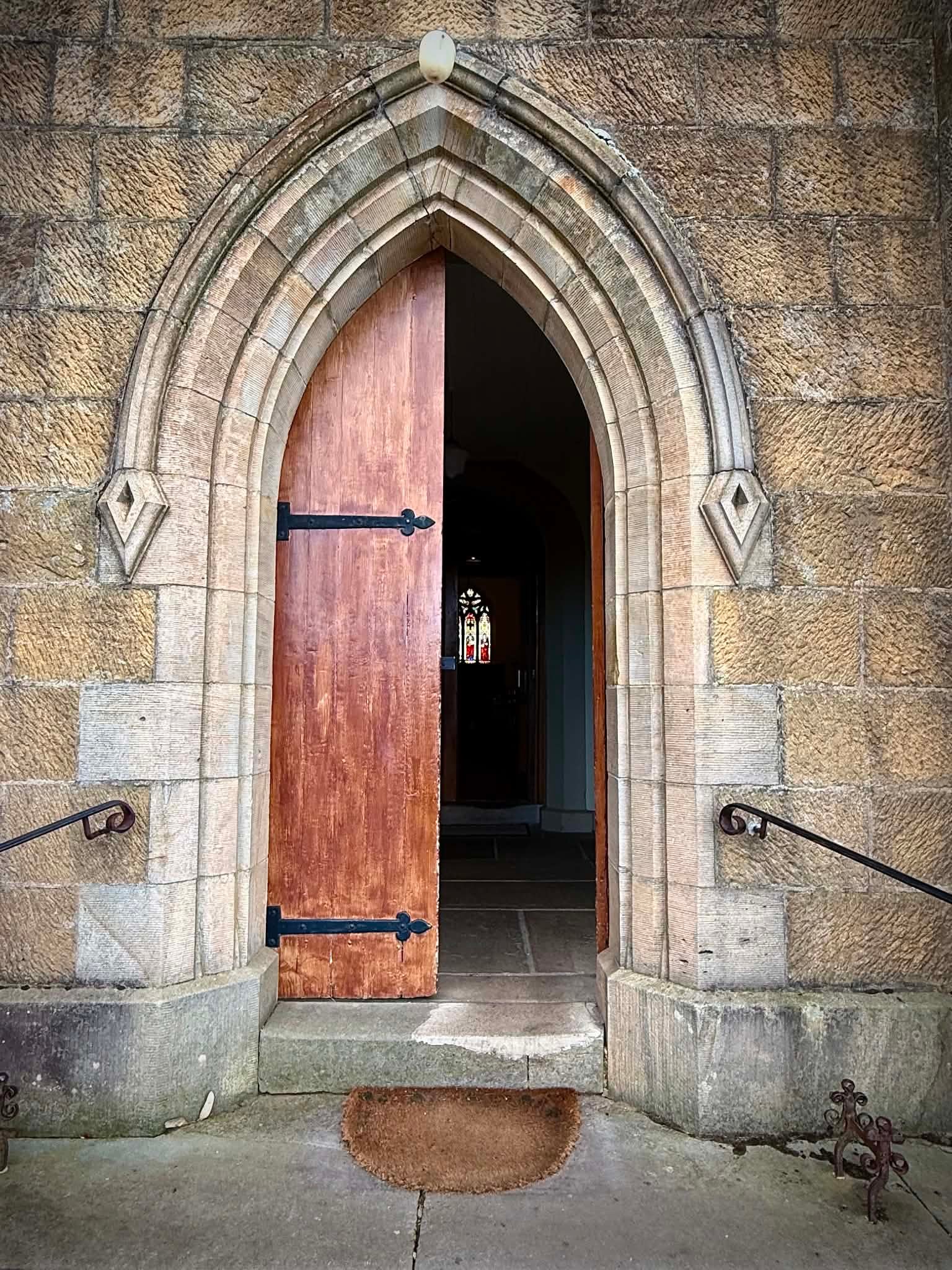
I wandered through the quiet alleyways, stopping for a red wine at a stone pub along the main street, before crossing the famous bridge and heading to the church atop a gentle hill, proudly overlooking the village. It was a small building, weathered by time, a large gum tree guarding its entry on the left-hand side. One of the wooden doors was open, just enough to see a stained-glass window glowing at the far end of the aisle. No one else was around. Between the unplanned day, the grey sky, and the cold winter air, I felt uneasy, like I was trespassing — disturbing a silence, and a history that wasn’t mine to interrupt.
However, the voice which had initially led me to Tasmania comforted me now. The unease wasn’t really about the church. It was about being somewhere with nothing to perform and no one checking in. I stepped inside. The cold stone, the quiet, the single window of coloured light — none of it asked anything of me. I sat in a pew that had held two hundred years of other people’s Sundays, and for the first time in longer than I could name, I wasn’t waiting for anything to happen. I was just there. That was the whole of it, and it was enough.
As part of the tour, there was an option to take a drive out to a nearby vineyard for some wine tasting. The others preferred to stay in town; I was the only one who opted for the extra stop, until the last minute, when a retired couple from Wales jumped on board. We wound through the hills to a stone cottage buried in vines. The husband preferred beer — I watched his face fall a little with every pour of red. But somewhere between the second tasting and the third, we stopped making conversation and started actually talking. It felt good to be listened to, and to listen in return, without either of us needing anything from the other.
By the time we’d collected the others from Richmond and made our way back to Hobart, my step count was almost sixteen thousand, my backpack felt like a rock, and it was time for a hot shower before the next day of adventures.
Nothing exactly life-changing happened that day, certainly not in any way that I was used to. As I stood at the red pedestrian light across the road from my hotel, forcing me to pause and reflect on my surroundings, I turned and noticed a church behind me. It felt similar to the one from earlier in the day. I was exhausted — But I was exhausted in a good way, worn out by travel and small encounters and quiet contemplation, and filled with something closer to relief than gratitude: relief that I had listened. Small changes. That was all it ever needed to be.
I quit that job four months later, for reasons that had little to do with Tasmania and everything to do with it. I still don’t understand how four ordinary days quietly rearranged something inside me. I only know I woke up in Hobart still impatient, still scattered, still the same person who couldn`t finish a project to save her life — and somewhere on that island, I let a voice I couldn’t see lead me somewhere I hadn’t planned to go, and that had started to change everything.